

Local

p6

Six KFD-positive cases in Hosanagar and one in Chikkamagaluru; a separate ward has been arranged at the public hospital

KFD (Kyasanur Forest Disease) cases have appeared as early as December in districts along the Western Ghats this year. In Shivamogga district, six cases have been detected, while one case has been reported in Chikkamagaluru district. The health condition of most patients is stable, and they are undergoing treatment. In Sonale Gram Panchayat limits of Hosanagar taluk, five cases have been confirmed. The Health Department has taken precautionary measures. Shivamogga: KFD (Kyasanur Forest Disease), which usually causes problems around January in the Western Ghats region, has shown early signs this year by surfacing in December itself. So far, six positive cases in Shivamogga district and one in Chikkamagaluru have been identified. Most patients are in stable condition and are receiving treatment. Infection detected in five people Last week, a 50-year-old woman from Billodi village, under the jurisdiction of Sonale Gram Panchayat in Hosanagar taluk, tested positive for KFD. Following this, more people who showed symptoms of the disease were tested, and five additional infections were confirmed. All the patients belong to Billodi village within the Sonale Gram Panchayat area. With the memory still fresh of a young woman from Bappanemane village near Sampekatte, who died of KFD last year, the emergence of new cases this year has caused public concern. It has been three years since KFD vaccination was available, making heightened precautionary measures essential. The Health Department is closely monitoring the situation. Meanwhile, in Negeri village under Kammaradi Gram Panchayat in Chikkamagaluru district, a 40-year-old man was recently found to be infected. This is the first case reported in that district during this period. Separate Ward A separate ward has been arranged at the Hosanagar Government Hospital exclusively for patients suffering from fever. Whenever symptoms are noticed, blood samples are being sent to a laboratory in Shivamogga for testing. So far, a total of six people in the taluk have been confirmed with KFD. Among them, four are undergoing treatment in Thirthahalli, while two were treated in Manipal. Of these two, one patient has recovered and has been discharged from the hospital. Doctors have informed that the health condition of all infected patients is stable. Six Monkey Deaths In Manjinakanu village, under the limits of Talavata Gram Panchayat in Sagar taluk, six monkeys died in the same plantation. Samples from three monkeys were sent to a laboratory for testing. Two samples tested negative, and the result of the remaining sample is yet to be received, sources told Vijaya Karnataka. Awareness on KFD Precautionary measures are being taken regarding KFD. The public has been instructed to compulsorily inform authorities if monkey deaths are noticed. Anyone experiencing fever is advised to visit a hospital immediately as a precautionary measure and receive treatment. Improvement has been observed in the health of all confirmed patients so far. There is no need to panic, but precaution is essential, said Hosanagar Taluk Medical Officer Dr. Shantaraj. Advisory for the Public
Six KFD-positive cases in Hosanagar and one in Chikkamagaluru; a separate ward has been arranged at the public hospital Read More »

p5

Bhadravati’s VISL Township is falling into ruin

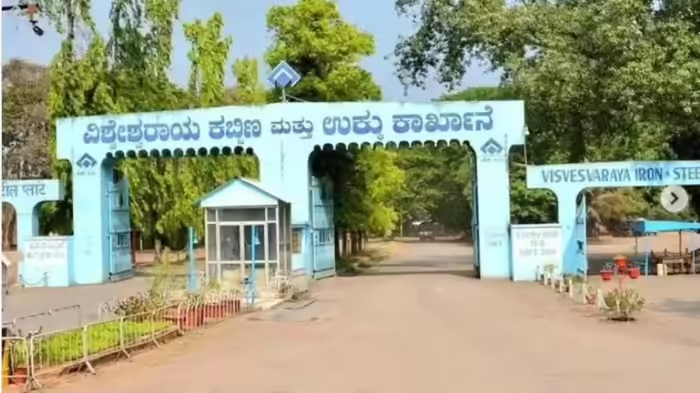
The township of the VISL factory in Bhadravati, Shivamogga, has now fallen into disrepair. Residential quarters, schools, and hospitals that once stood in grandeur have been neglected. Out of 4,200 houses, more than 500 have become dilapidated. All 14 welfare schools built by the factory have been shut down. Even the well-equipped hospital has fallen into ruin. The workers’ settlements now present a gloomy and sorrowful atmosphere. The township of the Bhadravati Visvesvaraya Iron and Steel Factory (VISL), which once served as a model for the state with its workers’ quarters, welfare schools, and hospitals, is now deteriorating. In the 1970s and 1980s, the area had a well-planned underground drainage system, proper rainwater canals, neatly aligned houses, and exemplary cleanliness with no garbage in sight—setting a standard for how residential colonies should be maintained. There was intense competition among workers to obtain these residential quarters. In the township that once witnessed days of grandeur, one now sees dilapidated houses everywhere—reduced to skeletal structures without doors or windows, overgrown with weeds—creating an atmosphere of gloom and desolation. A total of 4,200 residential quarters were constructed in the township for workers. Of these, 800 HUDCO houses near the Military Camp have already been sold. Out of the remaining 3,400 houses, about 2,200 houses have been leased to retired employees, while around 500 houses have been rented to government employees. 220 houses are currently occupied by serving employees and officers. More than 500 houses have become dilapidated and fallen into disrepair. As the workforce at the factory has declined, the residential quarters too have deteriorated. Roads and junctions that were once bustling with people and constant activity now wear a deserted look. The single- and double-storey residential buildings in New Town SWMC and Hutta Colony SWMC stand vacant, with their paint peeling off. Thieves have stolen the doors and windows of many houses, leaving them looking like skeletal structures. On some roads, people feel afraid to move around not only at night but even during the daytime. If the occupied houses are not properly maintained, many more homes will fall into disrepair within the next five to six years. Schools that have shut down: In addition to providing housing facilities for workers, the factory gave top priority to the education of their children and had constructed 14 welfare schools, ranging from primary to college level. Instead of the government, the factory itself directly managed these institutions. Vidyamandir, Silver Jubilee, Golden Jubilee, the JTS that provided technical education at the high-school level, and the VISJ Polytechnic, which was renowned for quality technical education, were among the major institutions. Most of these schools have now been shut down. Dilapidated hospital: The factory hospital, which once had a spacious building, well-equipped medical facilities, more than 25 doctors, and over 100 staff members, has also begun to fall into disrepair. The entire upper floor of the single-storey building has been completely closed, while nearly three-quarters of the ground floor has been shut, leaving only a handful of rooms in use.

Bhadravati’s VISL Township is falling into ruin Read More »

Lists
News
Home
Jobs
Contact